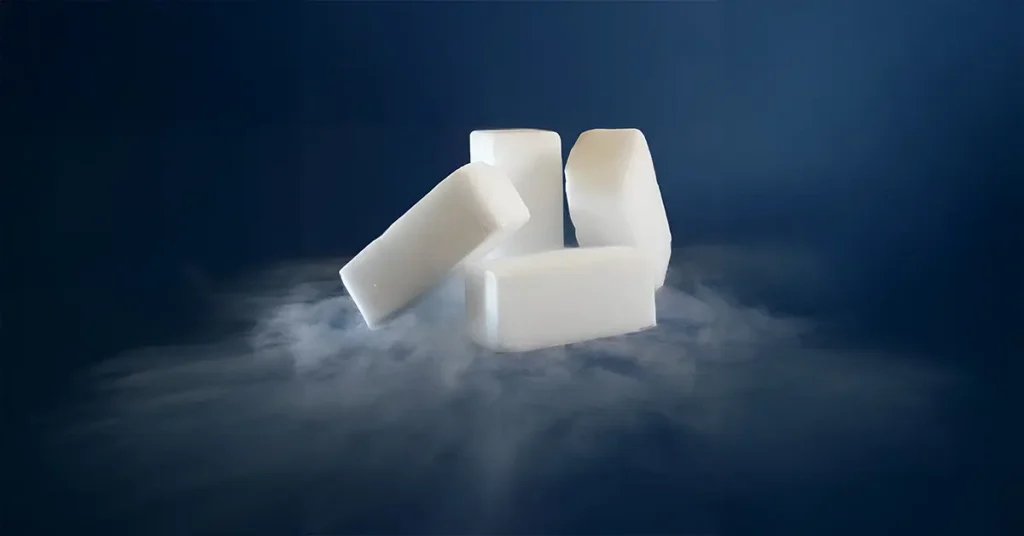
Dry ice has a wide range of uses that can meet the needs of different sectors. Especially in areas such as pharmaceutical production, chemical industry and food industry, frozen carbon dioxide (CO₂) plays a critical role as a cooling medium.
The production process of this special material is carried out under specific physical conditions. At a temperature of approximately -20 ° C and a pressure of 20 bar, liquid CO₂ is stored in low-pressure tanks. When this liquid is transferred to a specially designed pressure cylinder, both carbon dioxide gas and carbon dioxide snow are produced, thanks to reaching ambient pressure and rapid cooling. This snow, at a temperature of approximately -78.5 ° C, is molded by mechanical compression, and in this process, dry ice particles with a diameter of 3 mm and a length of 10 mm are formed.
It offers dry ice to the market in different formats according to user needs: pellet (granules), ingots and plates. Products from 10 kilograms are shipped by being placed in specially designed styrofoam insulation boxes according to demand. For larger demands, special container systems with a dry ice capacity of 600 kilograms come into play.
Key Advantages of Dry Ice Technology
The low hardness structure allows dry ice to be used safely even on sensitive surfaces. Thus, a wide range of equipment, from electronic parts to molds, can be cleaned with dry ice without damaging them.
The applied dry ice blasting process can be adjusted according to the type of surface to be treated. This flexibility ensures efficient results in areas with different surface structures.
This technique offers a more sustainable cleaning solution by replacing environmentally harmful chemical solvents. Using dry ice leaves behind only dirty residue that is separated from the cleaned surfaces.
During the process, the dry ice particles sublimate without leaving any waste, i.e. they disappear directly into a gaseous state.
Dry ice cleaning process is used to clean machines or production lines.only causes it to stop temporarily, which ensures thatloss of time and production is minimized